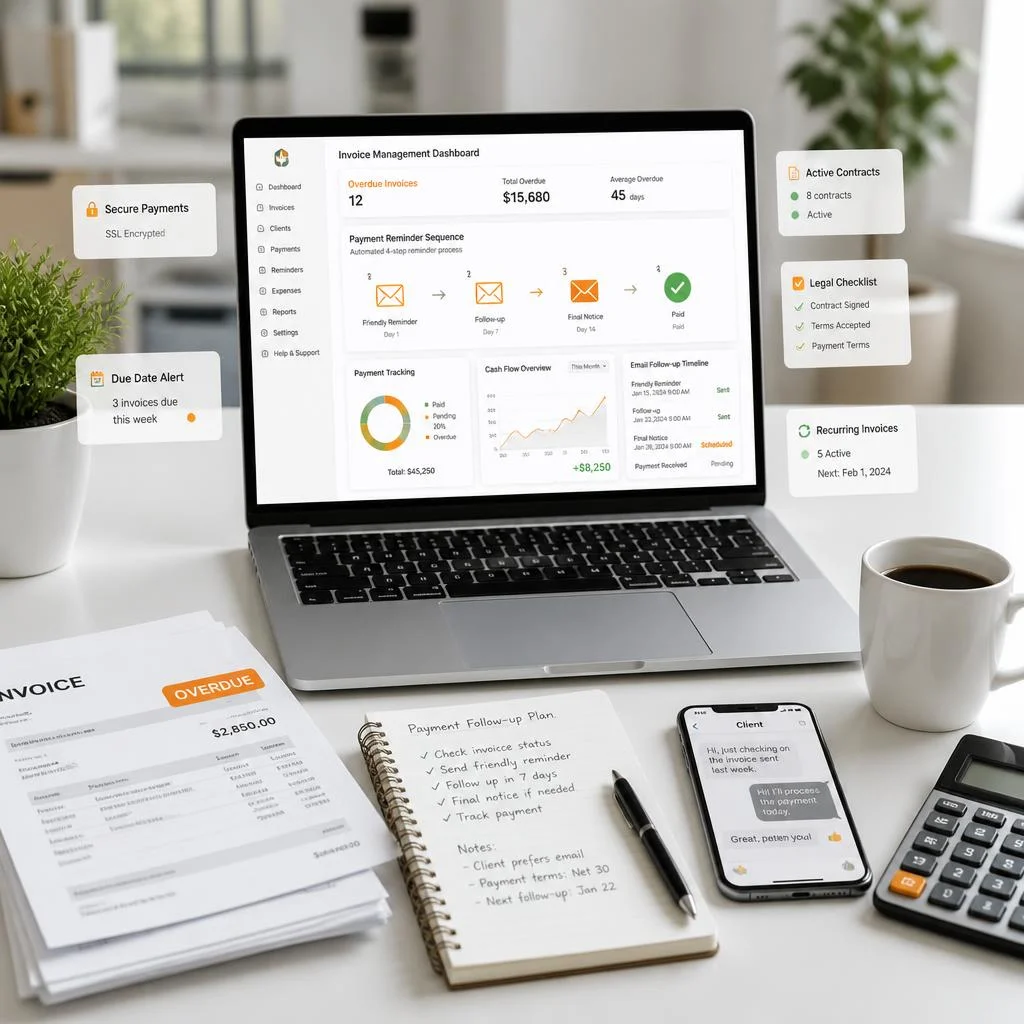
Late invoices are not a character flaw of freelancing — they’re a workflow you haven’t built yet. Clients pay the invoices that are easiest to pay and hardest to ignore. This is the complete system: the setup that prevents lateness, the four-email escalation (copy-paste ready), the short-message versions for chat-first clients, the phone script nobody wants to need, and the honest decision tree for when email stops working.
Before day zero: make late impossible to excuse
Half of “late” payments are invoices lost in a process, not refused by a person. Close the gaps before you need the sequence:
- Invoice to the payer, not just your contact — ask “who processes invoices?” at kickoff and CC them from invoice one.
- Everything they need to pay, on the invoice: PO number if they use them, due date as a calendar date (“due 15 August”, never “net 30”), payment method that takes minutes, your tax/registration details if their accounts team requires them.
- Terms agreed in writing before work starts: deposit, payment window, late-fee clause, pause-work clause. These are the teeth the emails below will reference — and clients who resist them told you who they were in the brief.
- Deposit sized to survive disaster: 30–50% up front means a total default still paid for part of the work.
The email sequence
Day 1 overdue — the friendly nudge
Hi [name], hope the week’s going well. A quick note that invoice [number] for [amount] fell due yesterday — likely just crossed in the post. Here’s the link/details again for convenience. Anything you need from my side to process it?
Assume innocence, restate essentials, make paying one click. Most invoices die here.
Day 7 — the direct check-in
Hi [name], following up on invoice [number] ([amount]), now a week overdue. Could you confirm when it’s scheduled for payment? If there’s an issue with the invoice itself, tell me today and I’ll fix it immediately.
A date is the deliverable now; the fix-it offer removes the last legitimate delay.
Day 14 — terms enter the conversation
Hi [name], invoice [number] is now 14 days overdue. Per our agreement, I’ll need payment confirmed by [date] — after that, late fees per our terms apply and I’ll pause current work until the account is settled. I’d much rather not; a payment date today solves it.
Calm, contractual, specific. Pausing work is your real leverage — a stated consequence, not a threat. (Late-fee amounts and rules vary by country and contract; the clause you agreed up front is what makes this line enforceable rather than decorative.)
Day 30 — the final notice
Hi [name], despite reminders, invoice [number] remains unpaid 30 days past due. If payment isn’t received by [date], I’ll pass this to [small-claims process / a collection agency] as a formal debt. That’s a worse outcome for both of us — please settle by [date] so we don’t get there.
Send to your contact and accounts. Most debtors pay when the next step stops being an email.
The short-message versions
Chat-first clients (WhatsApp/Slack/text) get the same ladder, compressed — send these as nudges alongside the email of record, not instead of it:
Day 1: “Hi [name]! Quick one — invoice [number] came due yesterday. Link’s in your email. Thanks! 🙂”
Day 7: “Hi [name], following up on invoice [number] — could you confirm a payment date today?”
Day 14: “Hi [name], invoice [number] is 2 weeks overdue now — I’ve emailed the details, but per our terms I’ll need a payment date today before continuing work.”
The phone script (day 14–21, when replies stop)
“Hi [name], calling about invoice [number] — it’s [X] days overdue and my messages haven’t caught you. Is there a problem with the invoice, or with the payment? … Okay — what date can I put down for payment? … I’ll confirm that by email today. Thanks.”
Two questions, one date, one written confirmation. Silence breaks on the phone far more often than in inboxes.
When email stops working: the honest decision tree
- Small amounts: weigh small-claims filing costs and your hours against the invoice; sometimes the professional move is a final firm letter, then writing it off and firing the client. (Bad-debt treatment at tax time varies by country — your accountant’s two-minute question.)
- Meaningful amounts: small-claims court is built for exactly this and the paperwork is your contract + invoice + the email trail you’ve been building. The trail is why the sequence above is written, dated, and polite throughout.
- Company clients going quiet: a letter addressed to their finance director or registered office often unsticks what a marketing contact ignored.
- International clients: enforcement across borders is hard — which is why deposits and milestone billing (pay-as-you-go, never more than one unpaid milestone outstanding) are the real protection for overseas work.
The structural fix
If chasing invoices is a monthly ritual, the problem is upstream: deposits too small, terms too soft, clients too flagged. And the stress of any single late invoice is exactly proportional to how much you needed it this week — the argument, again, for a real buffer and a rate with margin. Paid-on-time is a system, not luck.
FAQ
When should I send the first late-invoice reminder? The day after the due date — friendly, with payment details restated. Waiting a week teaches clients your due date is decorative.
Can I charge late fees on overdue invoices? Generally only if your contract or agreed terms included them up front — rules vary by country, which is why the clause belongs in every agreement before work starts.
When should I stop emailing and escalate? Around day 30, after the four-step sequence and a phone attempt: small-claims for meaningful amounts, a firm final letter or write-off for small ones — and no further work either way.
How do I prevent late payment on international clients? Deposits and milestone billing — never let more than one unpaid milestone accumulate, because cross-border enforcement is rarely practical.