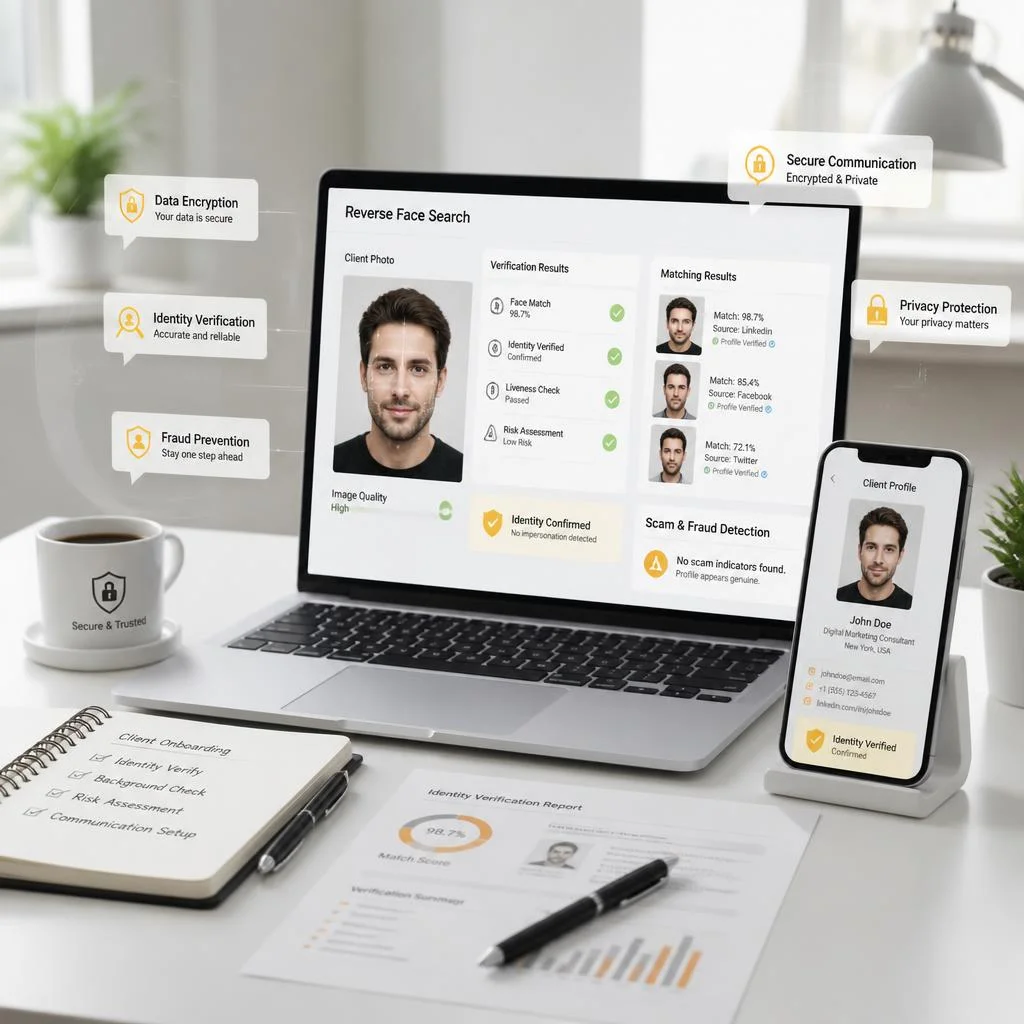
Searching for FaceCheck ID? For freelancers, this one has a genuinely practical use case: verifying that the “client” who just messaged you is a real person and not a stolen photo. Here’s the reverse face search engine through our vetting routine — the legitimate uses, the limits, and the line.
At a glance
What it is: reverse-image search for faces — upload a photo, find where that face appears online · Cost: freemium; full results typically paid · Legit use: scam and impersonation verification · The line: verification yes, surveillance no.
The freelancer use case
Fake-client scams run on borrowed faces: the “startup founder” whose photo belongs to someone else, the “recruiter” assembled from a stock portrait. When a new client arrives with a big project, an urgent timeline, and an unusual payment arrangement — the trio that already fails the brief test — a face search on their profile photo is a two-minute check. A photo that traces to a different name, or to a model’s portfolio, ends the conversation early and cheaply. Overpayment “refund” schemes and advance-fee “onboarding costs” almost always ride on these borrowed identities.
Limits and the line
Matches are leads, not verdicts. Face matching is probabilistic; lookalikes happen. Use a hit as a reason to verify further (video call, company email domain, official registries), never as a conviction. And the line: searching to protect yourself from someone contacting you is defensible; searching to identify strangers who haven’t approached you slides into surveillance — regulated in several jurisdictions, prohibited by most platforms’ terms, and on you. The mirror lesson: your own face is searchable too, which is worth remembering when deciding what to attach publicly to your professional profiles.
Verdict
A real tool with a real protective use for solo workers who get approached by strangers with money stories. Know the costs before uploading, treat matches as leads, and keep it strictly on the verification side of the line. Pair with the four-question routine when the “client” also comes with a website.
FAQ
Is FaceCheck ID free? Basic searching is typically free with paid credits for full results — check current pricing before uploading.
Can it definitively identify someone? No — results are probabilistic matches. Treat them as leads to verify through other channels, never as proof.
Is using it legal? Self-protective verification is generally the defensible use; biometric search rules vary by jurisdiction, and stalking or harassment uses are illegal and prohibited.